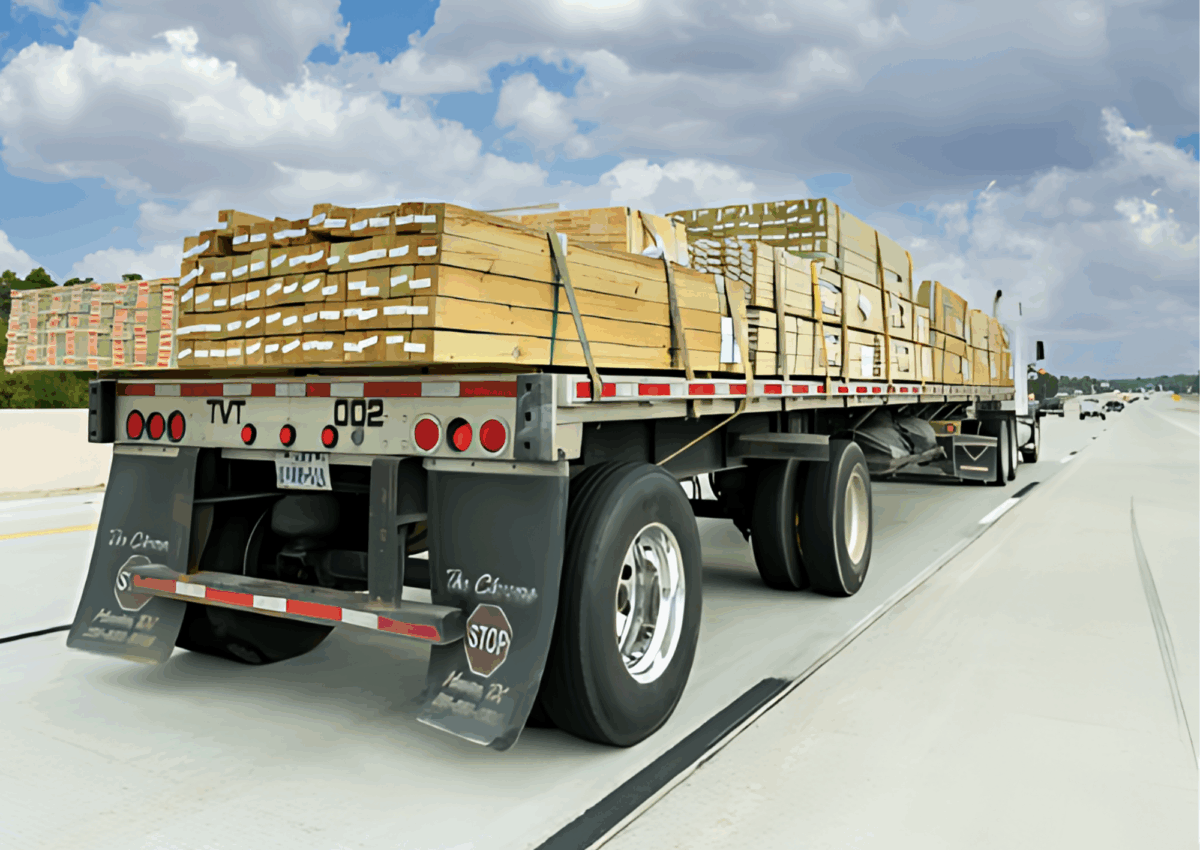
Let’s keep it simple: Lumber and steel are two of the biggest drivers of freight in this country. If people are building homes, warehouses, retail centers, data centers, transmission lines, and factories, you’re transporting materials—lumber, coils, plates, beams, structural steel, rebar. When this demand is high, you feel it immediately on your dashboard. When it cools down, you feel it too.
So where are we now and have we closed the year 2025? Lumber futures are falling, and steel demand remains warm in some pockets. This combination sends a very clear message to flatbed carriers: Expect mixed demand rather than widespread “every line is on fire” demand. Some areas will be crowded. Some will be silent. And the kids who survive are the ones who understand where the money is still – and where it isn’t.
Lumber futures rose sharply earlier this year, reaching as high as $695 per 1,000 board feet in August — the highest price in three years, driven largely by traders betting on tighter supply and higher tariffs on Canadian lumber. It wasn’t because America was suddenly building houses like crazy. It was mainly buying front-end tariffs: “Tariffs are going up, better load up before they get expensive.” Factories, wholesalers, manufacturers – all got inventory early.
Then the additional reality hit.
Mortgage rates remained high. Builders saw a slowdown in buyers. Commencement of single-family activities and cancellation of permits. Builders shifted from “how fast can we frame it” to “how fast can we move something we’ve already built.” The demand for wood did not follow the price. Now that we’re sitting in late October 2025, wood futures are back in the $590-$610/MB range, up double digits from August and recently hitting lows in weeks.
What it means in plain English is: the timber market is heavy. They have a lot of products. They don’t have buyers like they wanted. Manufacturers were expecting a strong fall build cycle, and that build cycle didn’t quite pan out. Again, you’ve heard it before, it’s all supply versus demand.
There are two main reasons for this weakness:
- Housing prices are still brutal. Buyers are holding back because the monthly payments are obscene, even if sticker prices drop slightly. This halts new single-family construction, which is the primary driver of flat bed loads such as studs, trusses, sheathing and roofing materials to subdivisions.
- The stock is sitting. Builders in many markets are now discounting prices or offering incentives just to move finished homes. If the last phase is not yet sold, you will not order frame packs for the next phase.
So instead of constant transportation—wood from mill to yard, yard to job, job to the next job—you pause. low speed Gap per week
If you’re a flat-loader who relies on heavy housing loads (think southeast bedrooms and sunbelts, roofing materials, truss packages, drywall), you’ll feel the softness first. You’ve probably felt it before: there’s more dying to get something decent, brokers holding down the rate because “it’s slow this week,” and more traffic just to keep the truck moving.
A price drop in wood is basically the market saying, “Housing isn’t absorbing the material fast enough.”
This is your first warning signal. When the log falls, the chamber is noticeably cooled. As the chamber cools, the flat bed softens.
Now, does this mean that timber shipping is going away everywhere? no. This means that you avoid “house building = easy money” in any county. Good logging routes into pockets of high growth (parts of Texas, Carolina, Tennessee, Alabama) will still exist. But they will be more competitive. You’re going to see more trucks looking for the same set of deliveries because demand is no longer widespread and guaranteed. It is purposeful and uneven.
Translation: If you’re living solely with new residential construction materials, you’re on a dangerous path. You need to either expand your service radius or start playing non-residential jobs (commercial buildings, distribution centers, solar fields, infrastructure jobs) to fill your week.
Steel: Weak overall, but not dead – and not the same in every lane
Now let’s talk steel.
Steel is the backbone of flat load-bearing – coils, plates, beams, fabricated components. When the steel moves, the flatbeds eat. When the steel slows down, you feel the trucks stacking up in places like Ohio, Indiana, Michigan, Pennsylvania, Alabama, Texas.
Here’s where steel stands near 2025:
Global steel demand is weak in 2025. Prices have been under pressure for most of the year because buyers — construction, manufacturing, export markets — haven’t done enough to absorb supply. We have a lot of capacity in many regions, particularly Asia, where prices are at or near historic lows.
In Europe, demand is also soft and the only thing keeping prices from completely dumping is production cuts and trade support. In other words: they turn off the ovens just to stop the bleeding. According to the September 2025 report, this scenario would reduce the overall utilization rate from 78 to 79 percent to around 70 percent, in what steel industry watchers describe as a “structural oversupply crisis.”
In the US, you have another layer: tariffs. The title sounds like a policy, but let’s talk about what it really means on the pier.
When imported steel is withdrawn from the market, domestic mills naturally retain more volume. That keeps U.S. production running even if global demand is soft. That doesn’t mean prices will explode — because demand isn’t booming yet — but it does mean U.S. factories are doing work that might have gone overseas.
Add to that a few bright spots: Infrastructure, energy, grid upgrades, pipeline components, utilities and heavy industrial work continue to consume steel in parts like Texas, Alabama, and along the Gulf and Mid-South corridors. Demand for flatbeds in those areas is still described as “warm” due to coil and industrial shipments, even as residential construction is cooling.
So yes, the overall steel sentiment for late 2025 is: Weak now, slow recovery maybe In 2026. But that’s not the whole story. It is not equally weak everywhere and it is not equally weak in every type of product.
Some U.S. steelmakers continue to post strong earnings outlooks related to non-residential demand — things like energy, auto and infrastructure construction — and metals recycling. If you are transporting flats, that’s where it should get your attention.
So what does all this say about Q4 2025 for beds?
Let’s break it down:
- Wood tells you housing is slowing, not increasing.
Wood futures fell from their peak in August to the $590-$610 range in late October. The peak was mainly fear and tariffs. The downside is reality: builders don’t work that hard. This means less constant, easy, and short-term construction material loads that feed new subdivisions. Expect more empty miles in residential-only markets unless you diversify.
- “Soft now, slow and promising grind later,” the steel tells you.
Analysts expect Foulad to remain weak until the end of 2025 and find a better position only in 2026. You will work for your loads. You’re going to negotiate, you’re going to see brokers who test you on rates.
- But steel isn’t dead—it’s just shifting.
Even with weak global demand, U.S. factories continue to fuel sectors such as energy, infrastructure, automotive, grid upgrades and industrial development. These projects require panels, beams, beams, coils and fabricated assemblies. This is all flat transport.
- Your top-grossing haul heading into 2026 certainly won’t be starter homes in a new subdivision.
For example, this steel will be used for power grid work, utility infrastructure, industrial sites, heavy equipment construction, and even data center construction. These businesses are less sensitive to interest rates than housing. Cities can slow housing starts. Applications cannot slow down network upgrades. Manufacturers cannot delay retooling forever. That is where it is needed.
- The “thrill of wood” model is tightening.
To haul a truckload or three that made its money on regional loads of lumber, trusses, roof trusses, fence panels to new construction sites? You will start to see more competition. They will do it now – because their steel work softened that week. So be prepared to defend your relationships, provide reliability and maybe expand your service area a bit.
bottom line
Wood and steel tell the truth before the wider market.
Lumber falling back after that price hike in August is a market that is quietly acknowledging: Housing isn’t strong enough to keep every flatbed busy with residential construction this winter.
Steel will remain soft through late 2025, with talk of a slow recovery through 2026, the market says: Don’t expect miracles, expect a rush — but pay attention, as certain areas related to infrastructure, the work grid, energy and manufacturing continue to move steel every day.
If you’re a sleeper, things will be a little slower with you for a longer period of time.
In other words: 2025 ends with a sort. If you’re smart about where you point that trailer, you’ll still get it.
About the Author


